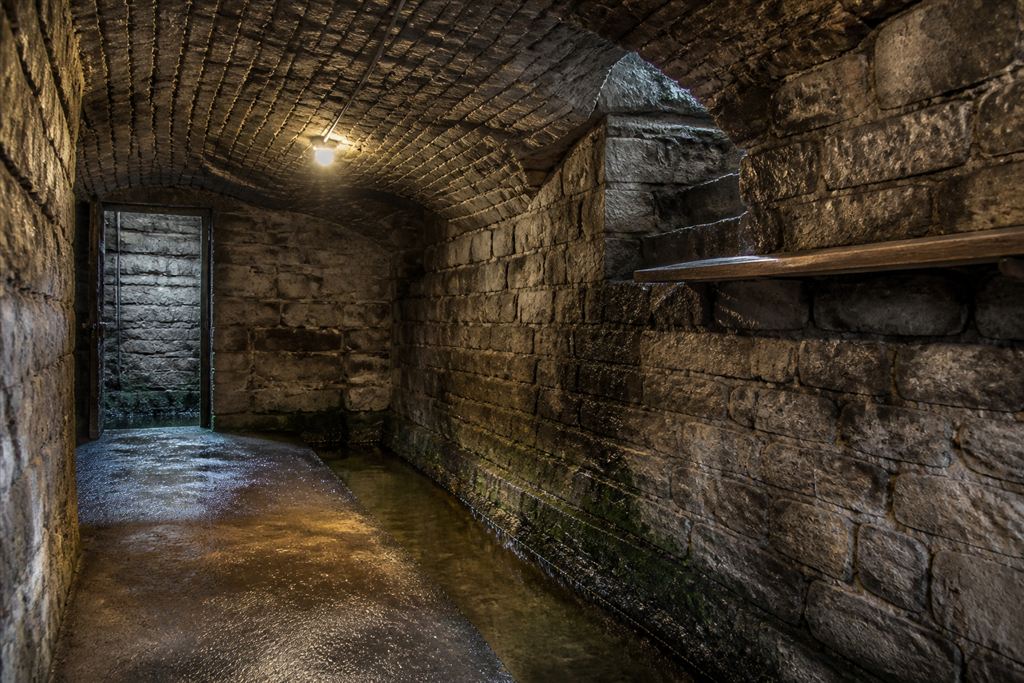
The homeowner phrase vs the system in the room
Cellar tanking, in conversation on Park Road or in Eldwick, covers three very different walls:
| What you can see now | What it usually is in Bingley | What we do after survey | |---|---|---| | Smooth grey coat, hollow in places, white salts at the base | Cementitious Type A slurry on millstone or brick that still sees groundwater | Strip the failed coat at the wet zone; do not overlay and trap canal, goit or Aire water against the masonry | | Black, sticky, crumbling behind shelves | Old bitumen / tar tanking, often a 1970s–90s “damp man” on a mill terrace | It is not a cavity. It comes off where it has lost bond. We do not paint membrane over tar and call it Type C | | Bare masonry, damp after rain or after a high river, no coat | No previous tanking; river / canal / goit / hillside drain depending on the plot | Specify Type C if the room is used; do not invent a slurry job because the search phrase said tanking |
Bingley Cellar Waterproofing does not sell a “cellar tanking service” as a synonym-spin of the other spine page. If the honest spec is cavity drain, we say cellar tanking is the search; Type C is the install. Type C for Bingley cellars
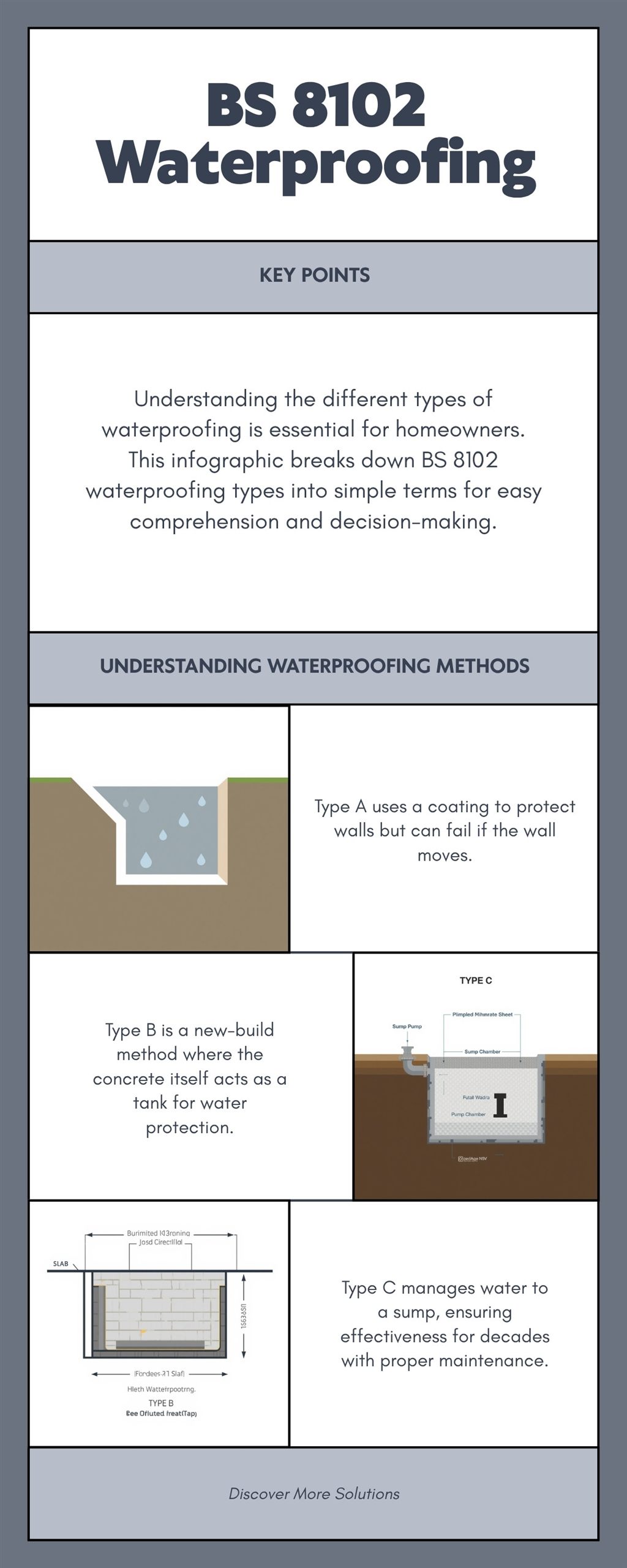
Diagram — BS 8102 types in plain English. Illustrative, not a site photo.
Why overlaying fails on the valley floor specifically
A Type A coat is a bet that the wall will not move and that water will not sit. On a Bingley mill terrace that bet is worse than on a dry uphill utility:
- Head of water. A perched canal pound at Five Rise, or groundwater in the Aire alluvium after a flood-week, is not the same as a film of clay water on a Leeds plot. Barrier coats blow at the joint first.
- Mixed masonry. Millstone, brick, later patching and a flag floor in one small room. Slurry loves a uniform substrate; this stock is not one.
- Goits. A buried leat does not care that you painted the wall last spring. It still wets the floor.
- Party walls. Overlaying the shared wall of a Park Road terrace traps water toward the neighbour. Type C does not need their brick to be dry.
Uphill at Eldwick and Gilstead the overlay problem is more ordinary — cracked slurry on later brick — and still not a reason to add a second coat. The *reason* differs; the *decision* (strip and drain) is often the same. Write that difference on the survey, do not hide it in one “Aire Valley tanking” paragraph.
When a limited tanking repair is still honest
Not every wet mark is a £10k–£30k Type C. A dry meter recess on a Priestthorpe semi, a single leaking pipe chase, or a chute reveal that can be detailed without a full cavity, can be a limited repair. We will say that. Stretching a slurry across a Myrtle Park cellar that has already taken river water is the dishonest version of the same sentence.
What is basement tanking, in the product sense (150 ): a barrier system. What basement tanking services (250) look like on mill /near-me/ pages: a town name bolted onto a kit. We mention those phrases so a homeowner who typed them is not lost. We do not become a shop for tanking membrane (1.7K — product SERP).
Existing coats and conversion talk
If you might convert later, a failed slurry is a gift in disguise: it comes out now, and the Type C goes in so a future floor finish sits on a drained cavity rather than on another grey coat. Conversion is still an upsell after the cellar is dry. Thin conversion mills already occupy "cellar conversion" Bingley-shaped URLs ; this page does not chase them.