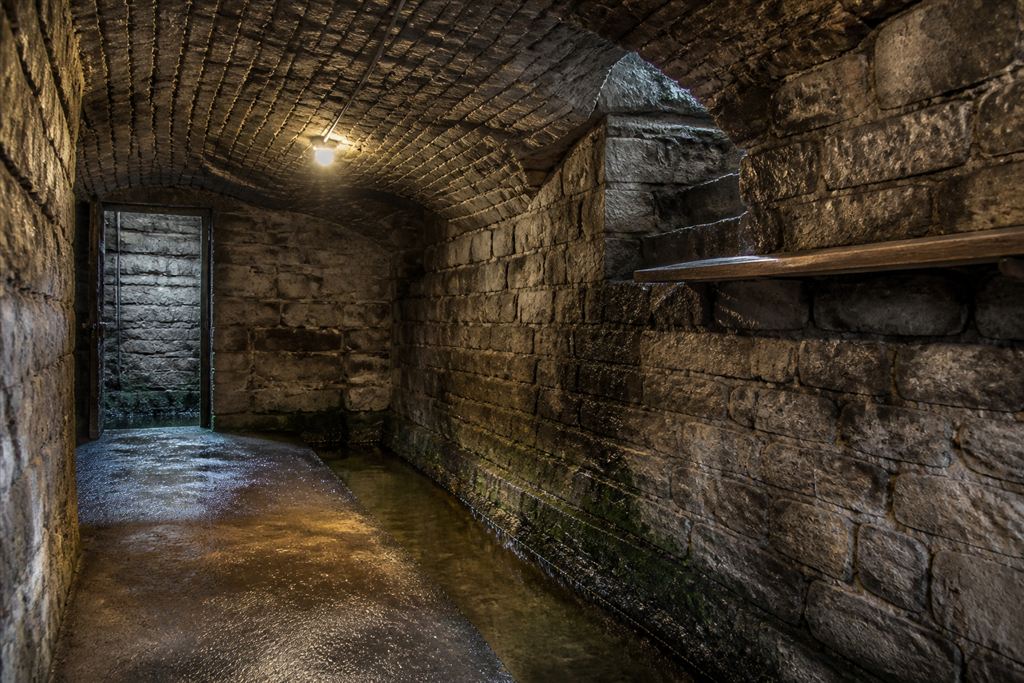
What “tanking a cellar” means on this stock
The phrase is used loosely. In Bingley it is not:
- painting a grey slurry on millstone or wet brick and calling it done while Five Rise holds a full pound
- buying a roll of tanking membrane and hoping a buried mill goit does not keep feeding the floor
- the same job as tanking a Worth Valley back-to-back with one exterior wall
- the same job as tanking a 1930s Leeds coal hole on clay
It is: decide how water that arrives from the Aire alluvium, from a perched canal, from a goit, or from a hillside drain is going to be managed inside this room so the floor you walk on stays dry.
Three construction facts about this town drive the spec:
- The source is not one source. A Myrtle Park cellar and an Eldwick cellar can both be wet after the same storm and need different discharge notes. Tanking a cellar here starts with which water, not with which kit.
- The canal is perched. Five Rise lifts the Leeds & Liverpool cut about eighteen metres. Barrier tanking on a wall below that cut is betting the masonry will hold a head of water it was never built to hold.
- Access is mixed. Mill-terrace stairs on Dubb Lane are not Eldwick hatches and not a Keighley front-room shuffle. The install is from inside; the survey says which inside.
What we actually install (not a kit)
On a typical Bingley cellar the sequence we specify after survey is:
- Record the room and the water — moisture map, invert of the existing drain, whether the plot is valley-floor or uphill, whether an EA flood map puts the house in play, party-wall thickness, stair or passage, where a sump can sit. That is the discovery survey.
- Prepare, do not “hack off the whole terrace”. Loose bitumen, failed slurry, and rotten linings come out. Sound original masonry stays. We do not strip a Park Road house to a shell because a supplier guide said so.
- Perimeter channel at the wall/floor joint, falling to a sump. On a one-room mill-terrace store that channel is short; on a larger town-centre stone cellar it is longer and the invert matters more — especially if the floor is already a goit-soaked flag.
- Cavity drain membrane on walls (and floor where the slab or flags are wet), fixed so the dimples create a drainage gap. Water that arrives through the Aire alluvium or a weeping canal pound runs in the gap, not across your stored boxes.
- Packaged sump and pump discharging to the existing combined drain wherever the plot allows — with a flood-event note on valley-floor houses, because that drain can already be full when the river is up. Where the water goes.
- Bradford Building Control application where the works are structural waterproofing, not a tin of paint. Bingley is Bradford district. The notice on a floodplain cellar is not the same note as a Worth Valley coal hole.
That package is Type C cavity drain in homeowner English. People still call it tanking a cellar. We keep the homeowner phrase in the title and tell the truth in the body.
This page is the job we specify. The companion page is what to do when slurry is already on the wall: cellar tanking vs Type C. Do not duplicate those sentences here.
Cost variables (not a kit price)
Tanking a cellar in Bingley is not a roll of membrane plus a weekend. Full Type C commonly sits in the £10k–£30k band. A small unused store that only needs a limited repair may fall out of that band — we would rather lose the job than stretch a slurry coat to look like a system. The lesson rule: this is high-ticket work, typically above £4k; callers who want a cheap patch are not this service.
What moves the figure on this town: valley-floor flood-zone discharge vs a clean Eldwick rear drain; mill-terrace party walls vs a detached Gilstead plot; access next to Five Rise vs a driveway on Lady Lane; how much failed Type A has to come off. What cellar waterproofing costs in Bingley
We will not put a fake “tanking a basement cost” number in the hero to chase that supporting phrase (200 ). Mentioned; not the H1.
What we are not competing with (do not copy)
National results for “tanking a cellar” are a supplier guide and a Scotland blog, plus a Peter Cox service URL that does not mention Bingley . Local quoted results are mill /near-me/ pages that swap BD16 2 into a template . This page is a service page for Bingley houses. It does not paraphrase Permagard, Richardson & Starling, Newton, Peter Cox, Core, or those mills.
FAQs
Our cellar sits below the Leeds & Liverpool Canal near Five Rise — is the water the canal?
Sometimes. The canal is perched above the valley floor, and a leaking pound can feed ground that a mill terrace cellar sits in. But river-level rise after rain and a failed hillside land drain produce the same wet floor. The discovery survey establishes which of the three it is before anything is specified — a canal-side spec and a failed-drain spec are different jobs.
Does a mill terrace near the Aire get the same tanking spec as an uphill Eldwick or Gilstead semi?
No. The terrace job is party walls both sides, a low invert, and discharge that has to respect flood-zone ground. The uphill semi is usually a single coal room on a slope with a clean rear-drain run. Both are Type C drained systems, but the channel layout, sump position and outfall are drawn per plot — that is why the survey comes first.
Does tanking a Bingley cellar need Bradford Building Control?
Bingley is in the Bradford district, so structural waterproofing work is notified to Bradford Building Control, not Leeds. A like-for-like internal lining with no structural change is treated differently from cutting channels and moving drainage. The survey write-up records which category your job falls in.
How long does tanking last in a canal-side Bingley cellar?
The lining and channel runs are a decades-long job; the variable on the valley floor is flood events, not the membrane. After a river-up spell or a known canal pound leak, the sump and channel get an inspection — that habit, not a thicker coating, is what keeps a mill-terrace cellar dry.